

Historically, value stocks have outperformed growth stocks in the US, often by a striking amount. Data covering nearly a century backs up the notion that value stocks—those with lower relative prices—have higher expected returns.
While disappointing periods emerge from time to time, the principle that lower relative prices lead to higher expected returns remains the same. Value premiums have often shown up quickly and in large magnitudes. For example, in years when value outperformed growth, the average premium was nearly 15%. On average, value stocks have outperformed growth stocks by 4.0% annually in the US since 1927.
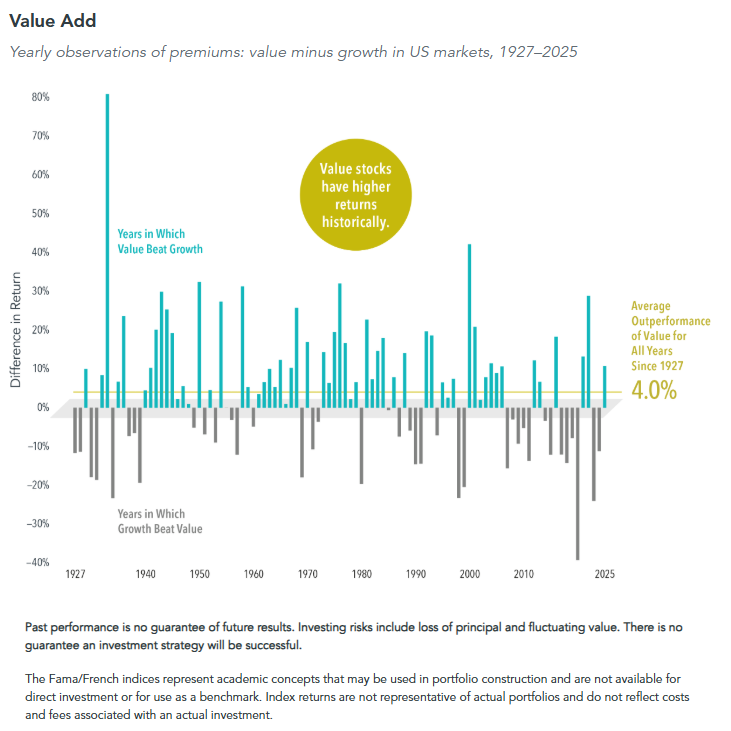
A consistent focus on value stocks is essential to capturing these outsize value premiums when they appear. Value investing is based on the premise that paying less for a set of future cash flows is associated with a higher expected return. That’s one of the most fundamental tenets of investing. Logic and history support a commitment to value stocks so investors can be positioned to take part when those shares outperform in the future.
Logic and history support a commitment to value stocks so investors can be positioned to take part when those shares outperform in the future.