
What is SBL and how does it work?
SBLs allow borrowing against investment portfolios without asset liquidation, offering flexibility and lower interest rates than traditional loans.
SBL lifecycle
The SBL process includes application, underwriting based on portfolio value, fund drawdown, and repayment stages.

Collateral and risks
Collateral includes diversified, liquid securities; risks include market volatility and asset concentration considerations.

Compliance and strategic use
Client suitability and compliance are vital, ensuring SBLs align with financial goals without triggering taxable events.
Leveraging SBLs for client liquidity.
Enabling liquidity without disrupting investment strategies

Maintaining investment strategies
SBLs enable clients to access liquidity without selling assets or disrupting their investment plans during market downturns.

Supporting diverse financial needs
Clients can use SBLs to fund large purchases, bridge financing, or support business ventures with flexibility and control.
Real-world applications of SBLs.
Fund real estate purchases, pay for education, or cover tax liabilities

Funding major expenses
SBLs can help clients fund real estate, education, and tax liabilities without selling investments.

Business capital access
Business owners use SBLs to secure working capital and finance expansion while retaining investments.

Bridge loans and market stability
SBLs act as bridge loans and provide liquidity during market volatility to avoid asset sales.
Building a vacation house: Two financing options, one better outcome
Bill and Amy need $1 million to build a vacation home. They have $4 million in their nonretirement
brokerage account, and they’re trying to decide whether it makes sense to liquidate a portion of their
portfolio or fund the construction using an SBL. They expect to need the funds until construction is finished
in a year, at which point, it will be easier for them to obtain a regular mortgage.
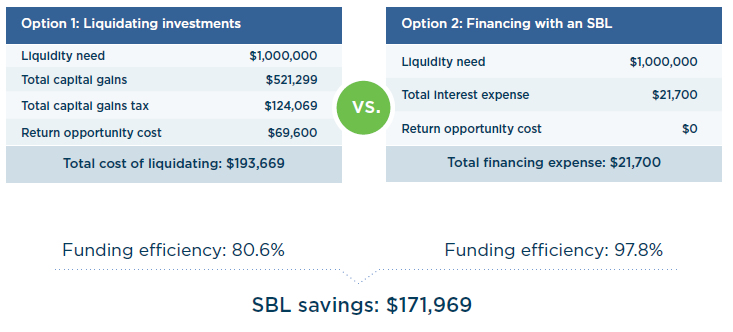
As their financial professional, you run a few numbers. You know that SBLs are economically advantageous when the cost of liquidation is greater than the cost of borrowing. The cost of liquidation includes any tax liability resulting from the liquidation plus the opportunity cost of lost potential future market returns. The cost of borrowing includes SBL loan interest. Bill and Amy have had their money invested in an S&P 500® index fund for approximately 6.5 years, which works out to an implied cost basis of $478,701 on the $1 million they would potentially liquidate—that is, they would owe capital gains tax on the amount of appreciation, or $521,299. Based on their holding period (6.5 years), tax filing status (MFJ) and AGI ($500,000), their long-term capital gains tax rate would be 23.8%
(20.0% LTCG rate + an additional 3.8% net investment income tax rate). This works out to be a $124,069 tax liability. In terms of the opportunity cost of lost market returns, let’s say you expect the market to return 7.96% per year, which is what the S&P has averaged since 1957. Given your 1.00% investment management fee, the return opportunity cost works out to $69,600 for one year. That said, the total cost of liquidation would be $193,669 ($124,069 + $69,600), while option 2 shows that the cost of borrowing has been quoted at 1-Month
SOFR + 2.00%, which yields total interest expense of $21,700 for one year (1-Month SOFR = 0.17%2). The conclusion is obvious: Using an SBL to fund the vacation home would be a much more efficient financing mechanism.